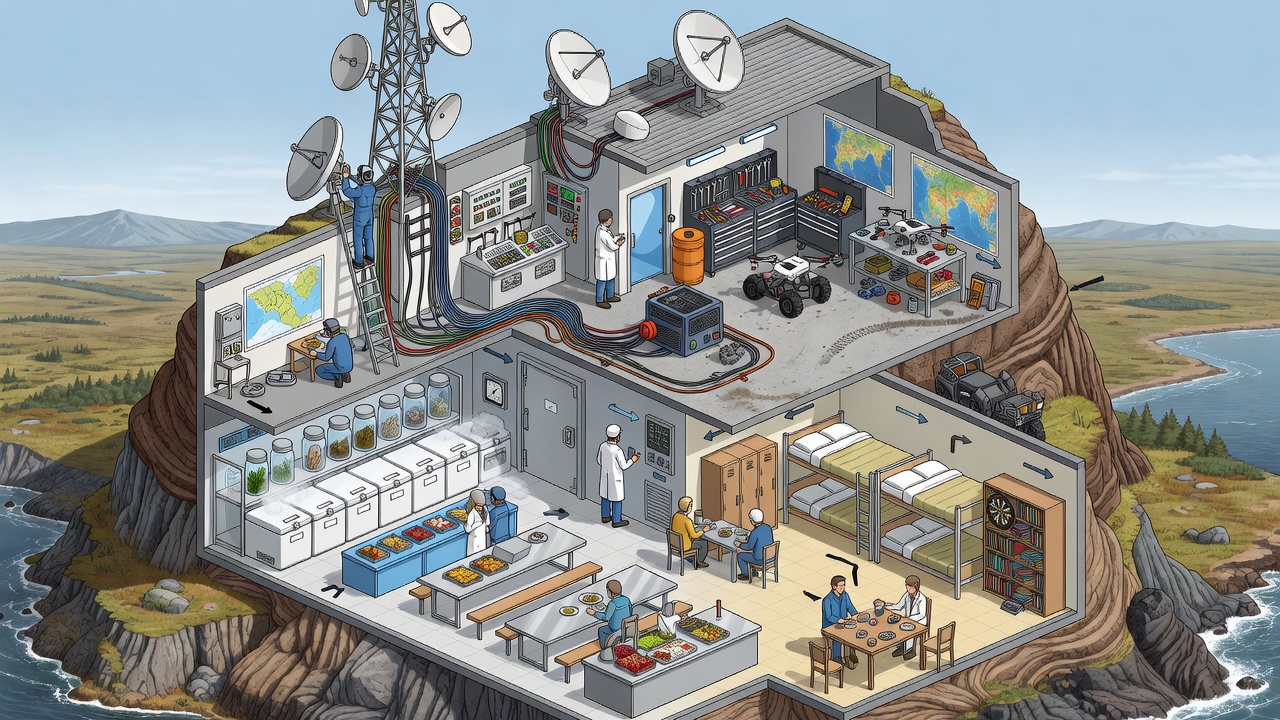
See the support system behind the science
A research station is often photographed as a small collection of buildings against a dramatic landscape. That image leaves out the system that keeps the work possible. Power, communications, water, food, maintenance, medical planning and waste management all affect what science can be attempted. A failed freezer or a delayed resupply can matter as much to a project as a sophisticated instrument. Understanding a station means following these dependencies rather than imagining an uninterrupted sequence of field excursions.
British Antarctic Survey operates Bird Island and Signy research stations in distinct island environments. Bird Island supports long-term work on seabirds and seals near South Georgia. Signy, in the South Orkney Islands, has its own research history and operational pattern. Their official pages describe real facilities; they should not be read as visitor invitations. A station's scientific importance does not create a right of access.
Recognise the different roles
Field researchers may collect observations, manage instruments and check records, but other staff maintain the conditions that make those tasks possible. Depending on the station and season, duties can be combined or highly specialised. A learner should avoid assuming that every person on site is a scientist, or that logistical work is secondary to the research. Reliable operations are part of the evidence chain.
- Scientific and field teams
- Work within approved projects, maintain records and assess the quality of observations.
- Technical and engineering support
- Maintain equipment, power systems and other infrastructure within their assigned responsibilities.
- Station management and logistics
- Coordinate resources, communications, movements and changing operational priorities.
- Data and sample stewardship
- Preserve identifiers, documentation and storage conditions so material remains interpretable.
These are conceptual roles, not a staffing list for any named station. Actual responsibilities are set by the operating organisation. Educational visitors, where explicitly permitted, remain visitors unless separately recruited, trained and authorised for a defined task. Attending a briefing or watching a procedure does not provide professional competence to repeat it independently.
Follow a sample beyond the shoreline
Imagine an authorised project collecting material for a later analysis. The field observation is only one stage. A sample needs a unique identity, associated metadata, suitable packaging and a documented route into storage. Temperature or preservation requirements may be time-sensitive. Export, import and transport rules may apply. If the connection between a container and its field record is lost, the material can become scientifically unusable even when it looks intact.
This is why station routines can appear meticulous. Labels, duplicate records, inventory checks and equipment logs are not administrative decoration. They protect the interpretation of results. A learning exercise can examine this process using empty containers and invented practice records away from sensitive environments; there is no need to collect wildlife or carry biological material to understand traceability.
Learn how constraints shape the working day
Weather, sea conditions and wildlife behaviour can change plans. A task may be postponed because the route is unsafe, because equipment is unavailable or because disturbance risks are unacceptable. Working remotely also means considering fatigue and the consequences of an incident far from immediate assistance. This page does not provide operational safety instructions. Staff follow their organisation's training, risk assessment and local procedures.
Ny-Ålesund on Spitsbergen offers a different model: an international research community with facilities and infrastructure supported by Kings Bay. The Norwegian Polar Institute is among the institutions connected with Arctic research there. The example shows that “station life” can mean a network of organisations rather than one isolated team. Research zones, instruments and local rules still require respect from anyone nearby.
Distinguish public learning from restricted access
Published station diaries, project summaries, data archives and institutional talks can reveal how research works without placing additional demands on an operational site. For subantarctic perspectives, the Australian Antarctic Division describes its work and facilities, including Macquarie Island. Read such sources for their particular remit and context; do not assume that procedures or access arrangements transfer unchanged to another country or island.
If you are considering a legitimate educational programme, ask who authorises it, what activities are actually included and how the operator separates visitors from ongoing research. Look for explicit limitations rather than vague claims of “scientist access.” We do not arrange station visits, place volunteers or endorse access requests. The most useful learning outcome may be a better understanding of why a working facility cannot host casual visitors.
Value continuity over spectacle
Many important records emerge from ordinary tasks repeated carefully over years. Maintaining an instrument, checking an entry and protecting a sample may be less visually dramatic than reaching a remote shore, yet these actions underpin comparisons across time. A station becomes easier to understand when you ask not “What adventure happens here?” but “What must remain dependable for tomorrow's observation to connect with yesterday's?”
Next: access and ecological limits