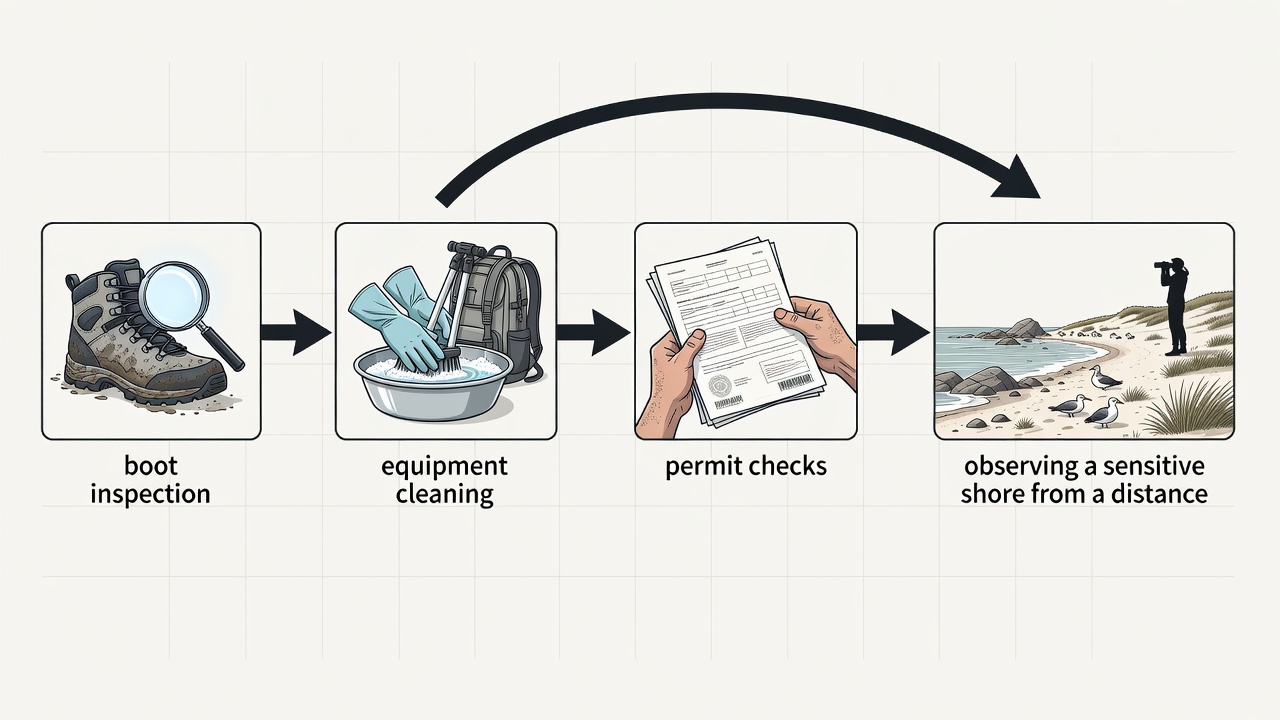
Begin with the option not to land
Educational value does not automatically outweigh ecological risk. A visit can introduce organisms, disturb breeding wildlife, damage slow-growing vegetation or add pressure to a small community. Some impacts are obvious; others may not become visible until later. Responsible planning therefore starts with a genuine alternative: learning through published records, remote observation or a less sensitive location. Choosing not to land can be a successful decision rather than a failed expedition.
Remote does not mean ungoverned. Islands may have resident communities, traditional connections, protected status, private land or several overlapping authorities. A transport booking is not proof that every activity is allowed. Before considering access, identify who is responsible for the place and which current rules apply. General educational articles, including this one, cannot replace that enquiry.
Separate the permissions
Permission to enter an area may be distinct from permission to conduct research, collect samples, handle wildlife, use a drone or install equipment. Filming and commercial activity can bring additional requirements. Even an activity that seems small, such as taking a soil sample, can have legal and biological consequences. Describe the intended action precisely when consulting an authority; the broad label “educational visit” is not enough to establish permission.
For Antarctic activity, the Antarctic Treaty Secretariat provides environmental and visitor guidance, while national competent authorities administer relevant authorisation processes. The International Association of Antarctica Tour Operators publishes visitor-related material for its operational context. Industry guidance is useful, but membership or a general code is not a substitute for the applicable law, permit conditions or site-specific instructions.
If an activity is not explicitly covered by the relevant approval, do not assume it is included. Ask the responsible authority before planning to perform it.
Treat biosecurity as a chain
Seeds and other biological material can travel in boot treads, hook-and-loop fasteners, pockets, tripods and bags. Cleaning at the landing point cannot undo every oversight earlier in the journey. Preparation begins before packing and continues between sites. Equipment used in one place may need attention before it enters another, even within the same island group. Destination-specific procedures determine what inspection, cleaning or treatment is required.
A visibly clean surface does not guarantee that it is free of pathogens. Do not improvise chemical treatments from a general article: the appropriate product, concentration and disposal method depend on the approved procedure and material involved. Follow official instructions and the operator's authorised protocol. Keep cleaned items separate from used equipment where instructed, and report a suspected contamination issue rather than hiding it to preserve a landing opportunity.
New Zealand's Department of Conservation describes controlled access and conservation requirements for the subantarctic islands. The Government of South Georgia & the South Sandwich Islands provides another jurisdiction-specific source for visitor management and biosecurity. These systems illustrate a shared principle, not a universal checklist. Rules for one destination should never be copied to another without checking their relevance.
Let wildlife needs set the boundary
Animals may respond to people before an observer notices a clear behavioural change. Distance, route, group size, noise and time spent nearby all matter. Follow applicable approach limits and local guidance, but do not treat a minimum distance as a guarantee of harmlessness. If your presence changes behaviour, withdraw as directed and report the situation to the responsible guide or authority. Do not feed wildlife or reposition natural objects to improve a photograph.
Protecting habitat also includes where you stand. Bare-looking ground may contain burrows or vulnerable vegetation. An apparently convenient route can cross an animal pathway or a monitoring plot. Stay within permitted routes and respect temporary closures. In Svalbard, the Governor's official guidance provides the relevant starting point for local environmental and access rules, rather than assumptions based on another Arctic destination.
Include communities and operational limits
Ask whose work and daily life make a visit possible. Local services, water, waste handling and emergency capacity may be limited. Respect local decisions and obtain appropriate permission for photography, interviews or the use of community knowledge. A research-themed itinerary does not confer special entitlement to people's time, workplaces or cultural material. Educational benefit should be described honestly, without turning a short encounter into an implied collaboration.
Weather and sea conditions can make access impossible even when permissions are in place. An ethical operator must be able to change a plan without pressure to deliver a promised landing. Ask about contingency arrangements and what a cancellation means before making commitments. We do not provide route planning, medical advice, rescue coordination or assessments of whether a particular voyage is safe.
Keep the learning claim proportionate
After an authorised visit, describe what you actually did. Observing a monitoring team is not the same as conducting its research. Helping with an approved citizen-science task does not establish a professional qualification. A careful account recognises the people responsible for the programme, the boundaries of your participation and the observations that remain uncertain. The most durable lesson may be that access is conditional, ecological care is ongoing and no destination owes us an arrival.
Continue: expedition questions