Begin with a relationship
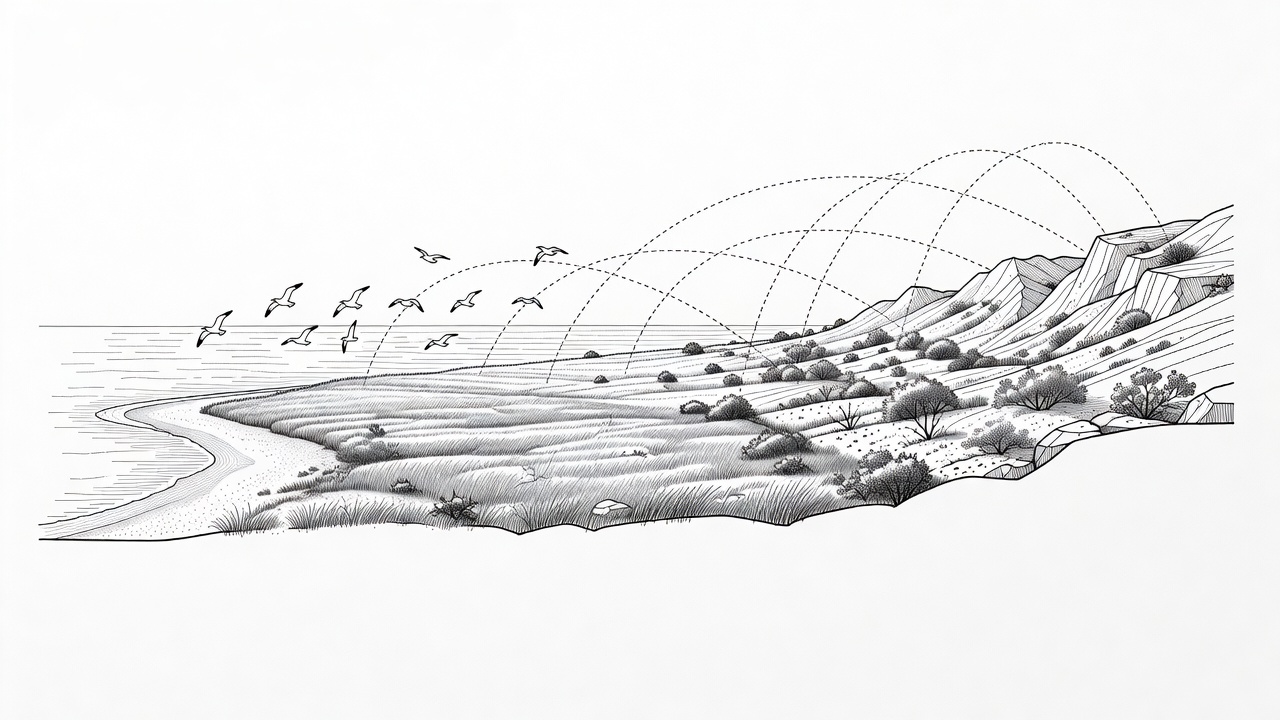
A remote island can look like a complete world with a sharp boundary at the sea. Ecologically, that boundary is porous. Wind carries seeds and insects. Birds move between feeding grounds and nesting sites. Rain washes material down slopes, while currents transport larvae past the shore. A useful first question is therefore not simply “What lives here?” but “What moves between here and somewhere else?” That question turns a scenic view into an investigation.
Galápagos offers a well-documented example of interacting marine and terrestrial systems. UNESCO describes the archipelago in relation to ocean currents and evolutionary processes. The Charles Darwin Foundation provides research and conservation context. Neither source makes every observation on every island interchangeable. Exposure, elevation, season and management history differ, so a learner should record the particular setting rather than treating the archipelago as one uniform habitat.
Trace connections from shore to slope
On seabird islands, marine-derived nutrients can reach land through droppings, prey remains and carcasses. Those inputs may affect soils and plant communities, but a greener patch beside a colony is not sufficient proof of the mechanism. Moisture, shelter, grazing and substrate could also explain a difference. A good notebook separates the observed pattern from the explanation being considered and lists plausible alternatives before drawing a conclusion.
You can practise that separation without approaching nests. From an authorised path or observation point, describe vegetation height, exposed ground and broad habitat boundaries. Record distance and visibility as limitations. Do not place a transect through a colony for the sake of an exercise. Proper ecological sampling needs a justified design, appropriate expertise and any required permissions; educational curiosity alone does not authorise intervention.
Understand endemism without simplifying it
An endemic species has a natural distribution restricted to a particular area. That area might be one island or an entire archipelago. Isolation can support distinctive evolutionary histories, but small ranges may also expose species to concentrated threats. Introduced predators, disease, habitat change and extreme weather can have consequences that are difficult to reverse. “Remote” does not mean untouched, and a lack of visible buildings does not demonstrate an absence of human influence.
Aldabra Atoll, managed by the Seychelles Islands Foundation, illustrates the importance of protected island systems and carefully managed access. Macquarie Island, described by UNESCO, provides another perspective through its subantarctic environment and conservation history. These are not equivalent ecosystems. Comparing them is most useful when you ask which processes might be shared and which depend on climate, geology or the species present.
Read the island across timescales
A brief visit is a narrow sample of time. Breeding birds may be offshore, plants may be dormant, and a recent storm may have altered the shore. An apparent absence could reflect timing or poor detectability rather than a genuine ecological change. Long-term monitoring reduces some of these uncertainties by repeating observations with documented methods. It still requires interpretation: changing equipment, observers or survey routes can affect the record.
Gough Island and Inaccessible Island, recognised together by UNESCO, show why island conservation must consider globally important breeding populations and external pressures. Their protected status is not an invitation to land. For an adult learner, published management material, photographs with reliable context and monitoring summaries can support meaningful study without adding disturbance at sensitive sites.
Build a low-impact learning record
Choose one modest question, such as whether visible plant cover changes between sheltered and exposed ground along an existing permitted route. Note the date, general weather, viewpoint and limits of what you could see. Avoid recording precise locations of vulnerable nests in material you plan to share publicly. Do not remove seeds, shells, rocks or biological material simply because they appear common; collection rules and ecological effects vary.
Finally, write two conclusions: what your observations support, and what remains unresolved. You might confidently describe a habitat contrast while remaining uncertain about its cause. That is a successful educational outcome. The aim is not to turn a short encounter into a sweeping claim, but to learn how careful questions connect places, processes and evidence. Continue with the methods notebook when you are ready to examine how a formal study would test those questions.
Next: evidence in the field